South Africa Trip, 5/24-6/5
Every two years, the Yale Concert Band goes on a concert tour somewhere outside the U.S. Two years ago, my freshman year, we went to Mexico over spring break. This year, we went to South Africa and Swaziland.
Our flight left from JFK on Tuesday, 5/24, at 11:15 am, and landed in Johannesburg about fifteen hours later at 8:35 am local time. After picking up our luggage, the first thing we did was exchange our money. The local currency is the South African Rand, and the exchange rate is about 1 USD to 7 ZAR (South African websites also end in .za). I decided to exchange $100 USD, thinking I probably wouldn't spend it all, but actually spending it all.
After we exited the airport, we boarded a coach bus and went to a safari park! Entering the safari park, we had to drive through a narrow gate along a curved path. Somehow, with less than six inches of leeway on either side the of the bus, our bus driver managed to squeeze through without hitting or scraping the bus against anything . I'm always impressed by how well bus drivers can maneuver their vehicles.
Our safari was pretty exciting. We got to drive right up to what our guide said was a young, but still pretty massive-looking, lion. Literally, our safari car was less than five feet from the lion, and fortunately, the lion just chilled there. It seemed pretty content. Probably, it had been fed recently. (Apparently, the lions get fed dead cattle. Later, for lunch, which was a braai (the Afrikaans word for barbecue), we tasted how delicious the cattle were, and we remarked that the lions get fed well here!) Then we drove up even closer, and the lion, frightened by the size of our car, scuttled off. Later on this safari, we saw larger lions, including ones that looked like adult Simbas, with a full mane of hair. These lions were fenced in.
During the safari, we also saw giraffes, zebras (including pregnant ones) (Our tour guide pronounced zebra as "zeh-bra"; he also pronounced the letter z as "zed". We had a discussion about how the world pronounces z as "zed" and it's only Americans that pronounce it "zee". Even Canadians - we have two such flute players - pronounce it as "zed". Americans are just weird, what with our inches, feet, miles, ounces, pounds, and Fahrenheit, just to name a few.), kudus, springbok (South Africa's national animal), and wildebeest.
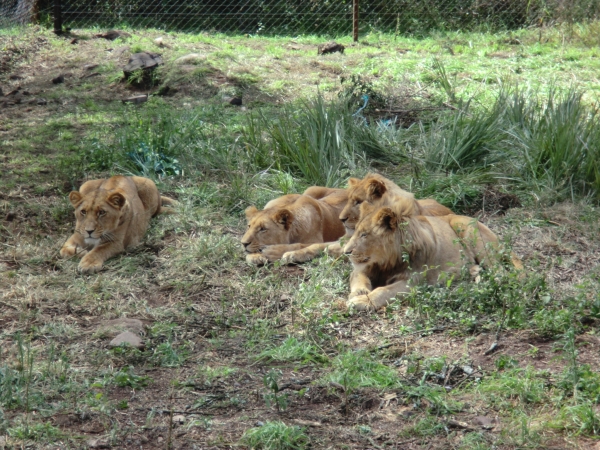
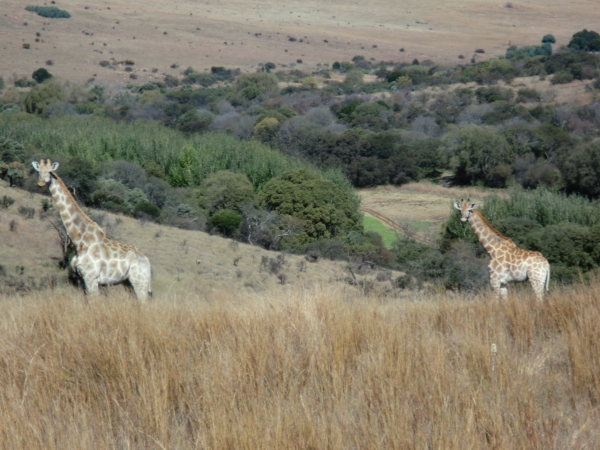
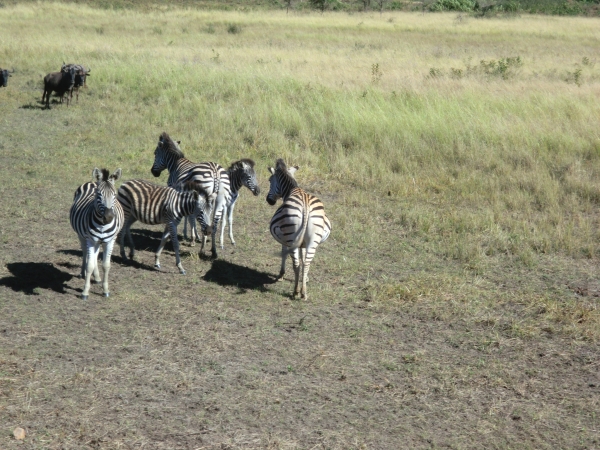
Pregnant zebra
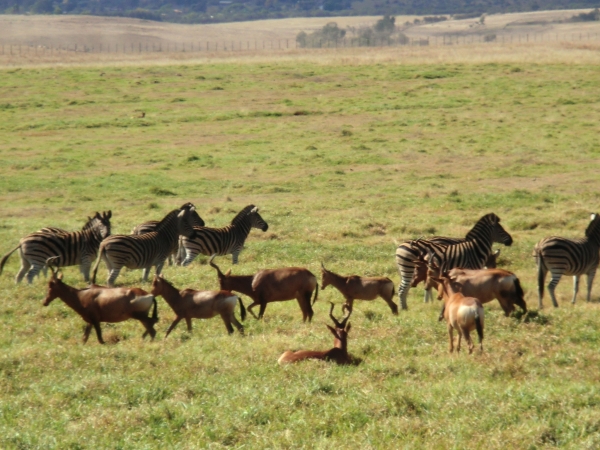
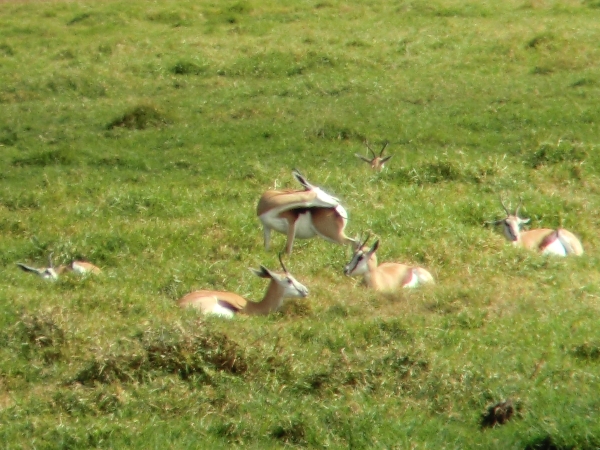
Several days later, we went on a sunrise safari in Swaziland. There, we saw ostrichs for the first time and also saw more zebras and many types of antelopes (gazelles, kudus, springbok, impala, and klipspringers).
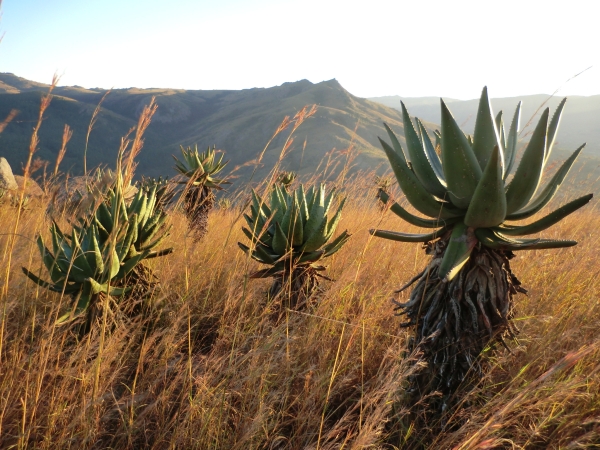
During this safari, we also drove up a mountain and watched the sun rise over Executioner's Rock, which is where they used to fling off capital criminals to their deaths. Hiking down from the summit back to our safari cars, we passed by these plants that looked like Exeggutors or Oddishes:
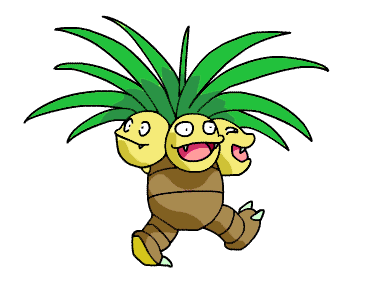
Exeggutor

Oddish
We hoped to see hippos and crocs on this sunrise safari, but alas, they evaded us. Another animal I never saw was the elephant. I think these larger creatures are more common in more inland Africa. I did see a rhinoceros, though, chilling in the fields next to a strip mall. Overall, I was happy with the amount and variety of exotic animals native to Africa I got to see.
After the first safari outside Jo'burg (as many people call it), our tour guide showed us this poop-spitting game. He picked up a small sphere of dried kudu dung, popped it in his mouth, leaned back, and then ejected it as far as possible. I tried it as well. So did our conductor Thomas C. Duffy and a few other people. It's not easy spitting something far. It takes practice and good technique. For the record, our conductor spit the kudu dung the furthest.
After the safari and braai lunch, we went to North-West University Potchefstroom campus and attended an African drumming workshop there. I was pretty exhausted by this point due to jet lag. The fact that I was sick - congested and coughing a lot - didn't help. A vacation trip is probably the worst time to be sick because you never really get a chance to properly rest and recover. You're doing so much during the day, and at night, you want to hang out with your friends instead of sleeping. Consequently, I ended up being sick during the whole trip. But how did I get sick in the first place? Well, leading up to the tour departure date, I stayed up late several nights in a row, pulling several near all-nighters. Here's what happened:
- Saturday-Sunday, 5/21-22: I essentially stayed up the whole night with most of '012 helping edit the class of 2012 movie (the premiere was Sunday night).
- Sunday-Monday, 5/22-5/23: Most of Sunday, I spent editing the '012 movie. In addition, I had a rehearsal for a concert, the concert itself (the twilight concert), and had to help move equipment. At around 12:30 am Monday morning, we premiered the '012 movie. By the time the screening finished, it was about 2 am. Seven hours later, I was helping to set up for Commencement and then played in Commencement.
- Monday-Tuesday, 5/23-5/24: After Commencement, I helped move equipment back to the Band Room (the BRoom) and then ate lunch with some bandies. I took a nap in the afternoon and woke up in the late evening. Call time at Hendrie Hall for tourgoers was 6 am. I probably should have just slept some more, but instead, I decided to stay up all night hanging out with bandies, most of whom were leaving on Tuesday, too, or going on tour with me.
- Tuesday-Wednesday, 5/24-5/25: Most of this time was spent on an airplane. Fifteen hours. Plus a six-hour time zone change. I did sleep a little on the plane, but my internal clock was already super messed up from staying up late so many nights in a row.
Consequently and not surprisingly, I was sick. Not enough sleep leads to a weak immune system, which leads to sickness. At various points during the tour, I lost my voice, had a sore throat, and had a fever, and throughout I was always congested and had a sickly cough. To recover from such sickness, the best remedy is generally to spend a day sleeping. I never got a chance to do this. In fact, I lacked the discipline to even spend more hours sleeping during the nights; I chose instead to hang out with my fellow bandies. The last night in South Africa, I also stayed up most of the night hanging out. When I got back to the U.S. in the morning of Sunday, June 5, I was still sick. I flew to California the next day and felt a little better by then. Then, on Tuesday, June 7, I started my internship. By lunch time, I had a fever, and I felt miserable the rest of the day. I biked home and went directly to sleep. Ten hours later, I woke up and felt much better. Finally, I had gotten over my sickness. I've been healthy ever since.
That was a pretty lengthy tangent. Now back to the trip. In the next installment.
Tomorrow, hopefully.
Post Comment
Technical Difficulties
My parents had gone on a cruise in Dubai earlier this year and had purchased a set of different adapters for it. I forwarded them the blurry picture of a South African plug that the band business manager sent me -
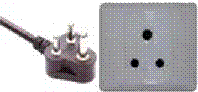
- and then my parents gave me this adapter, which looked the same:
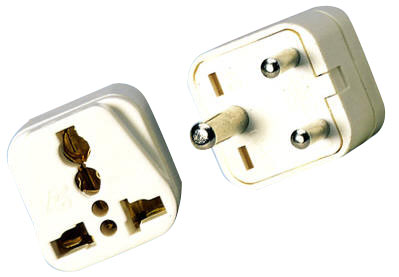
The first night in South Africa, I quickly discovered that the 3-pronged adapter I had brought was not the same as the 3-pronged South African plug. It was a little bit too small. Apparently, my adapter was an Asian adapter. This was a reminder to me that I should always do my own research.
Fortunately, our band president, Mr. Jared Bard, had brought the correct plug, so we took turns using it to charge our cameras, cell phones, and laptops. My Dell laptop's battery now no longer consistently charges. Only about 5% of the time that it is plugged in will it charge. It also has a relatively short battery life. Consequently, I now never use my laptop unless it's plugged in to an outlet. Thus, unable to use my laptop, I instead continued writing in my notebook about my Cornell visit.
Next up: first full day in South Africa.
Post Comment
Day 3 of tour - first full day in South Africa
In Mexico, the tap water is known to have micro-organisms that can cause diarrhea to travelers. When I was on tour there two years ago, I made the bad decision to buy a slushy, and a few hours later, Montezuma's Revenge hit. I think the ice in the slushy was probably made from unfiltered tap water. If you grow up in Mexico, though, I think your body will get used to the bacteria, and then you can drink unpurified tap water.
In South Africa, the tap water is very clean and safe to drink in developed areas. I saw many articles online emphasizing the purity of South African water. This was very reassuring. During the trip, I refilled my water bottle several times with tap water (filtered through a Brita water filter I brought to improve taste), and I never had any stomach or intestinal problems, despite being sick in other ways (see two posts ago). Only in Swaziland did I solely drink bottled water. However, one thing I did notice was the absence of public water fountains in South Africa. In the U.S., they are ubiquitous - in airports, department stores, museums, etc. When I got off the plane in South Africa, one of the first things I looked for was a water fountain in order to refill my water bottle, but I never found one.
After breakfast at Sunset Café (Sunrise would have been more appropriate), we went to North-West University to rehearse with their wind ensemble, which was only about six months old. Their music program focuses on voice and piano, and only recently have they established a wind ensemble and jazz ensemble.
In the afternoon, we went to the Potchefstroom Mall, and there, I was able to find a South African power adapter. Looking at my receipt and counting my change, I thought I had gotten back more money than I deserved. I asked the tour guide about this, and he explained to me that in South Africa, the VAT (value-added tax) is already included in the price. The price you see is exactly what you will pay. This system is definitely more straightforward for consumers, but it's probably a bit harder for businesses to separate revenue from taxes. Also, I later found out that while 1 South African rand is subdivided into 100 cents, the smallest unit of currency is 5 South African cents, which is worth approximately seven-tenths of a U.S. penny. This fact probably makes calculations a bit trickier. You can't just round to two decimal places - you have to round to the nearest twentieth of a rand. I wonder how banks deal with this.
That night, we split a concert with the North-West University Wind Ensemble. As an encore, we played a song called Bawo Thixo Somandla (the Thixo is pronounced tee-k (tongue click)), which is about asking God for help in times of distress and has been adopted as a protest song, such as during the final years of apartheid in the early 1990s. Some of the audience members really got into the song and started dancing and singing along.
Speaking of tongue clicks, I and many other band members spent a lot of time (especially bus rides) trying out the various tongue clicks that exist in Zulu.
Overall, the first concert was good - certainly much better than our first concert in Mexico, where we had this horrendous rhythm asynchrony that developed during Fiesta Mexicana. That night, now that we all had the correct power adapters, we could all charge our devices. However, we still didn't have Internet access, so I just started typing up what I had written about my Cornell visit.
Tomorrow: Soweto.
Post Comment
Day 4 - Soweto
After breakfast at the Sunset Café, we left to take a tour of Soweto, which is located southwest of Johannesburg. The name Soweto comes from SOuth WEst TOwnship, which is what Soweto used to be called. This town really highlights the vast differences in development in different parts of the country and shows just how poor and poverty-stricken the lower class is. There are millions of homeless people who are on the government waiting list for houses, which are being built by the government and charity groups. In Soweto, we passed by many squatter camps, located right along the main roads:
Sometimes, next to a squatter camp, you would see new, modern apartments that were built. The sharp contrast was very jarring. Some houses have also been built by the government for some of the squatters, and though they are small and tightly-packed together, it is certainly an improvement from the shacks that the residents used to live in. At least now they have plumbing and electricity. Our tour guide also pointed out that people have started to paint and beautify their homes and plant their own gardens. It's a sign of progress and it's uplifting to see these people take pride in their homes. There is hope among the poor that some day they will be able to move up into better housing and a better life.
Tomorrow: Soweto continued.
Post Comment
Ice Cream Cho-co-late!
In Soweto, we visited the Regina Mundi (latin for "Queen of the World") Church, which is the largest Roman Catholic church in South Africa, and was a place people gathered during the anti-apartheid struggle. Afterward, we went to the Nelson Mandela House, where Mandela lived before he served his 27 years in prison. Outside, while waiting to go in, we saw a contortionist performing:
After that, we went to the Hector Pieterson Memorial, which honors the hundreds of children, including Hector Pieterson, who died in the 1976 Soweto Uprising, where students protested the mandate that the language of instruction be half in Afrikaans. The dead body of Hector Pieterson was carried down the street by Mbuyisa Makhubo, another student, and this action was captured in this iconic image:
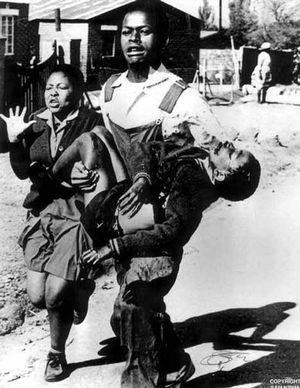
In honor of this incident, we all ran from the marker where Hector Pieterson was shot down the street to the museum. After spending a couple hours in the museum, we boarded the buses outside and prepared to leave Soweto. This was when we encountered an ice cream vendor outside the museum who chanted:
The chant stuck, especially the "ice cream cho-co-late!" part. For the rest of the tour, people would randomly break out into ice cream cho-co-late chants, and that's what my Facebook album is named after. No one is really sure what the second phrase in the chant is, but we've adopted "caramel cho-co cho-co mint" as the standard after our band social chairs used this text in an email they sent out in South Africa. Even our tour guide and band director started saying "ice cream cho-co-late" by the end of the tour.
Toward the end of the tour, while in Cape Town, I actually saw a street vendor selling ice cream cho-co-late and couldn't resist buying some.
Tomorrow: Visit to the African Leadership Academy and the Voortrekker Monument.
Post Comment