Cornell Visit, 4/22-4/25 - Day 0 (4/21)
Yale's spring semester starts fairly early - the second full week of January. This year, classes resumed on Monday, 1/10. The first week and half of classes is Shopping Period for us, and I didn't need to submit my finalized schedule until Thursday, 1/20. Monday, 1/17, was Martin Luther King, Jr., Day, and classes were canceled. Since this is during Shopping Period, and there are a lot more Monday classes than Friday classes, the administration decided that on Friday, 1/14, Monday classes should meet instead. Consequently, to balance things out, on the last day of classes - Monday, 4/25 - Friday classes meet instead.
My only Friday class this semester is Linear Algebra with Applications (MATH 222), a problem-solving based linear algebra class. I should have taken this class my freshman year, except Kate Mayans and I thought it was too easy, so we decided to take Linear Algebra & Matrix Theory (MATH 225), the proof-based linear algebra class, instead. This turned out to be too hard, and we both dropped the class midway through the semester. Kate transferred to the problem-solving linear algebra class (MATH 222), while I dropped math altogether, deciding just to go with an easier semester. Consequently, I never learned linear algebra properly and just picked up bits and pieces of it when I needed to:
- in Mathematical Tools for Computer Science, the CS version of Discrete Math, when I had to do Gaussian elimination
- in Probability and Statistics, when I learned about Markov chains and random walks
- in Ordinary and Partial Differential Equations with Applications, when I had to solve systems of first-order linear equations
- in Graphs and Networks, when I learned about representing graphs with adjacency matrices, and calculating useful things about graphs by finding the eigenvalues of their matrix representations
On Thursday, 4/21, I went to my last Randomized Algorithms class and my last Readings in American Literature class, and then returned to Swing Space. (Aside: in case you're curious what Swing Space looks like, you can take a virtual tour here.) At 4 PM, I went to a Master's Tea with Joshua Foer, who is a freelance journalist that went to cover the U.S. Memory Championships, but ended up getting coached by British Grand Master of Memory, Ed Cooke, and winning the U.S. Memory Championships the following year. A few weeks earlier, I had read an article by Foer in the NY Times Magazine called "Secrets of a Mind-Gamer".
I found several things Joshua Foer wrote about in his article very captivating. First off, he opens the article with a description of his walk through his memory palace, which he used when recalling a deck of cards en route to breaking the U.S. record for memorizing a deck of cards. This reminded me of the method I use to memorize a 4x4. Though I don't use a memory palace, I utilize the same idea of adding as much imagery as I can in order to make the memory as vivid as possible. I map letters to each of the 24 edge positions and the 24 center positions, and then, when I am memorizing the cycles of pieces, I create wacky sentences out of the string of letters, to help me better remember them. For examples of some wacky sentences, see this post. It's true though that the way to remember abstract information is to make it as vivid as possible. In his talk, Foer mentioned the Baker Baker experiment, where half the participants were asked to remember the name Baker while the other half were asked to remember the occupation of baker. A week later, more of those asked to remember the occupation baker were able to recall the word. Turning Bakers into bakers is the essence of the idea behind memorizing large amounts of information quickly. Names are very abstract, but the occupation of a baker arouses images of bakeries and the smell of delicious pastries. To illustrate his point, he said one way you could remember his name (Foer) was to imagine a big numeric 4 gashed across his face, with him bleeding profusely from the wound. Now this image is stuck in my head, and I might never forget it.
At the Cornell Spring 2011 cubing competition, during my only successful blindfolded solve, I was trying to recall the corner permutation cycles. I knew which six pieces needed cycling, but I couldn't remember the order. But I remembered waving my hand around in the air and drawing triangles to represent the cycles while I was memorizing the cube. So I kept drawing different triangles in the air until I drew a triangle that felt right. The motion felt the same as the motion I used while memorizing the cube. I went with it and I successfully solved the cube. (Video of this part of the solve.)
Another part of the article that I found interesting and inspiring was the paragraphs about the three phases of learning something new. He says the first phase is intellectualizing the task and discovering new strategies for doing the task. In the second phase, we make small optimizations to become even more efficient and don't make as many major mistakes. In the third phase, the task has become autonomous; we do it on autopilot.
Psychologists used to think that when you hit a wall where you can't seem to get any better - Foer refers to it as an O.K. plateau - that you've reached the limit of your innate abilities, and no matter how hard you try, you won't be able to improve. But more recently, research has shown that in most instances, the wall is not due to innate limitations but rather the limitations we place on ourselves - our personal standards and level of satisfaction. When we feel that we can do a task well enough, we set it on autopilot. This works for day-to-day routines like showering, brushing your teeth, etc., and is useful so we can focus our mental energies on more important matters. But when we are trying to get better at something, whether it's memorizing a deck of cards or increasing our free throw percentage, we should avoid the third phase of autopiloting.
Top achievers typically follow the same pattern of avoiding this third phase. They have developed strategies to prevent falling into this autonomous stage. These strategies include focusing on their technique, staying goal-oriented, and getting feedback immediately after a performance. Amateur musicians will spend their practice time just playing through music whereas professionals will spend it working through tedious exercises and the difficult sections of pieces. Psychologists have found that the best way to type faster is to force yourself to type 10 to 20 percent faster than what feels comfortable. Only by allowing yourself to make mistakes and observing where and what causes you to make mistakes can you fix them and improve your typing speed.
In Foer's talk, he told some more interesting stories. He echoed his claim in the article that photographic memory is a myth. He says he and most memory competitors have pretty average memories in general. In fact, he said that after winning the 2006 U.S. Memory Championships, he took his family and friends out to dinner and then took the subway home, only to realize upon arriving at home that he had driven to dinner. Memory competitors are only good at memorizing numbers and random words and decks of cards because they have specifically practiced for these events and developed techniques for them, like memory palaces. It's difficult to just apply these techniques to day-to-day memorization on the fly. It takes practice and focus to use them effectively. And in day-to-day living, technology is much-better suited for the task of memorization, freeing our minds for other things.
Foer also told a story about a lady he interviewed who could remember what she did on every day of her life. Every morning, as she was in the bathroom doing her thing, she thought back one year ago about what happened that day, then two years ago that day, and three years ago, and so on. By doing this every day, she was able to keep fresh in her mind what happened to her on every day of her life. Foer's comment on this lady was, roughly, "It's quite amazing what she can do. But if you put your mind to it, you could probably do it, too, if you cared enough to remember every day of your life. But that brings up the question, do we care to remember every day of our lives?" I found this very inspiring. Not that I care to remember every day of my life, but I do believe if you care about something enough and put your mind to it, you can do it. By caring, combined with the effective practice techniques (avoiding the autopilot stage), you can break through any walls you hit.
Foer shared many other interesting stories and pieces of information, all told very humorously. I was captivated by his talk and his article and really enjoyed his sense of humor, so I ultimately decided to buy his book, Moonwalking With Einstein: The Art and Science of Remembering Everything. Can't wait for it to arrive from Amazon.
After that fantastic Master's Tea, I hurriedly packed my bags and then biked to Old Campus. I locked my bike to a bike rack and then waited at Phelps Gate for the Yale shuttle to take me to Union Station. The train ride to NYC and then the bus ride to Ithaca were uneventful. I slept some and also finished my Linear Algebra homework due the next day and on Monday. I got to Cornell at 1:25 am; Ken picked me up and we went to the Mac Lab in the chemistry building (Baker Lab), where he finished his pchem and physics homework while I cubed. I liked how all the computers had Harry Potter names and the printer was named Fawkes. In the Harry Potter-themed computer lab, I also met a classmate of Ken's named Luna. How fitting.
By the time Ken finished all his work and we got back to his room, it was 3:30 am. We tried to scan my linear algebra homework, but we couldn't figure out how to use the scanner, so I ended up taking a picture of my homework instead. Then I emailed it to my friend Hannah Perfecto, who printed it out and turned it in for me. It was 4 am by the time we went to sleep.
Post Comment
Cornell Visit, Day 1 (4/22/11)
The previous night, on our way back to his room, I asked Ken, "Do you ever wake up early to finish up work instead of staying up late to finish it?" He responded, "No. It's too risky. What if you oversleep? What if you don't finish? What if you encounter difficulties?" Personally, I often wake up early instead to finish work, and when you're short on time, you usually just have to sacrifice quality. Especially for a problem set, if you've looked at it ahead of time and have a gist of what each problem is about, you can usually estimate pretty accurately how much time you need to finish it. When I'm tired, I have a hard time concentrating, so I find it's usually better for me just to sleep for a few hours and then tackle the work using the fresh energy you have after waking up (and overcoming any grogginess). Also, for me, if I stay up to finish work, I usually just end up procrastinating more because I feel like I have the whole night to finish my work, but I'm not factoring in sleeping time. When I sleep first, I've already done the sleeping and have less time remaining, so I'm less likely to procrastinate, knowing my limited time remaining.
Speaking of finishing problem sets, I asked Ken if he ever skips class to finish work for another class. "Never," he said. "I've never missed a class in my three years here." What?! Usually, I already started missing classes by the second week of the semester. Sometimes I choose to catch up on sleep rather than attend class and other times I decide to skip a class in order to prep or do work for another class.
Ken's reasoning, however, for never skipping class, is - what if during the one class you skip, the professor covers something that's on an exam? Maybe something important will be said that's not in the lecture notes (assuming the professor even posts them online), or he'll explain something in a different (and possibly clearer and easier) way than the textbook does. I have to agree with Ken though that it's best not to skip class. I've noticed that even if I'm half asleep for most of the class and don't understand much of what the professor is saying, the act of being there and trying to listen to and understand the professor will leave a lasting impression. Often, later on, when I do finally read the textbook or work on a problem set, memories of relevant lectures will come back to me and I'll suddenly understand what the professor had been saying. It'll help me focus in on the important concepts. I might not understand my notes as I'm writing them during a byzantine lecture, but after having read the textbook, I'll often come back to my notes and finally understand them.
Never skipping class is one of Cal Newport's tips in How to Win at College, and from my experience, it seems to make sense, even though I do still skip class sometimes. The effort to catch up due to a missed lecture can often consume more time than the length of the lecture. Newport also points out that attending class boosts your academic confidence. When you skip class, "you will feel guilty, behind, and lazy," and this tends to lead to poor performance. When you attend class, you get first-hand exposure to the material that the professor finds most important, how to analyze and approach that material, the collective answers to all the questions asked by the class, and the opportunity to ask clarifying questions yourself. I'm definitely going to make it a goal next semester to always attend class. Class is non-negotiable.
On our way back to Ken's dorm - the Hans Bethe house - he commented that he has a small room, that he wasn't sure if I could sleep comfortably in it. Well, when we reached the Hans Bethe House, I noticed there was a nice big lounge with lots of couches. I commented, "Ooh, I could sleep in the lounge if your room isn't big enough." Ken responded, "No, you are not sleeping in the lounge. I will not let you sleep there." Ken said he'd be embarrassed if his friend were sleeping in as public a place as his building's lounge. As it turned out, I did fit on the floor of Ken's room, and fortuitously, Ken had a sleeping bag I could use a mattress. His room was small, though; there was not enough floor space for another person to sleep comfortably on. If I had my way, however, I probably would have slept in the lounge. I've slept in the lounge areas of the computer science buildings countless nights, and I've also slept in the common room of Morse College. I don't really care too much if other people see me sleeping there. Ken says I have no shame.
Before we went to sleep Thursday night / Friday morning, Ken told me his schedule for Friday. He had two classes in the morning, philosophy section, and then physics lab. So many classes! Fridays have always been the least busy day for me. I tend to take classes that meet only Mondays and Wednesdays or Tuesdays and Thursdays. If I do have class on Fridays, it's usually a discussion section for a class or the occasional MWF class I take.
After only about five hours of sleep, we got up to get ready and eat breakfast before Ken's classes started. I brought my backpack with my work and laptop, and my flute carrying case, which held my Rubik's Cubes:
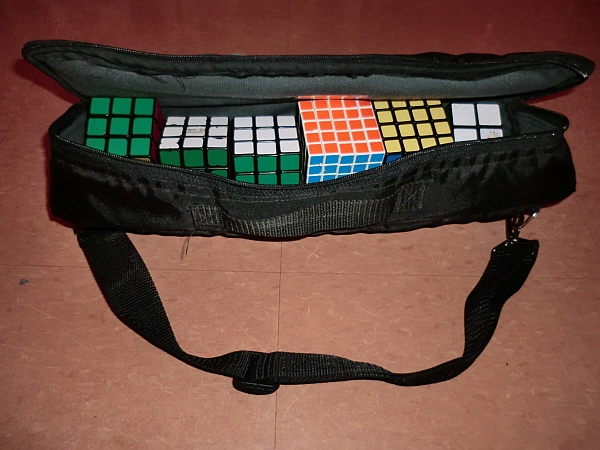
Even though Ken's dorm - the Hans Bethe House - has a dining hall, he refuses to eat there because he claims, "The food is terrible." Thus, we went next door to the Flora Rose House to eat breakfast. Since my travel expenses to get to and from Cornell were pretty substantial ($135 total = $28 for Metro-North Railroad round trip + $107 for Short Line Bus round trip), my goal during my stay at Cornell was to not spend any unnecessary money. (I was successful; the only money I spent was $13 for the Cornell cubing competition registration fee.) Ken only had two guest swipes left, and he said it wasn't worth it to use one on breakfast. Instead, he got a banana and peanut butter bagel for me. While Ken was eating, I practiced some piano in the lounge for my keyboard lab final exam (it's part of the Elementary Musicianship II class I took this semester). After breakfast, we went to class.
Ken's two morning classes were physical chemistry (pchem) and physics. He said he really hates both his professors for these classes because "they suck at explaining things." He also mentioned that the pchem professor doesn't really seem to know what he's talking about half the time, and his physics professor always has computer/projector issues, even though he uses them every class. Some things that were cool about the physics class were the demonstrations the professor did - on Friday, he did a demo illustrating the photoelectric effect, and on Monday, he did a demo involving filtered light (red, green, blue, and white) and voltage of this box that was similar to a capacitor - and the little remotes that each person in the class had that allowed one to vote on questions he showed in his PowerPoint. I tried paying attention during these classes, but due to boredom, lack of understanding, and five hours of sleep, I soon dozed off in both classes.
For lunch, we ate at Trillium. This was an à la carte style restaurant where students could use their dining dollars. Ken had about $150 left, and he bought a noodle + 2 sides combo for each of us. We ate with two of Ken's friends, Ashley and Wang, who were working on a crossword together. I also did a cubing demonstration for them.
Ken had philosophy section after lunch and had to leave a bit early. I wanted to come sit in on his section, but he said it was a small group and wasn't that interesting, so I shouldn't come. Well, after I finished eating, I decided to try and find his section. Ken said it was in Rockefeller Hall, and I was able to find it by running around and asking people for directions. I actually ran past Rockefeller and bumped into Ashley, who directed me backward to the right building.
Once I got there, I peeked in a few classrooms, didn't see Ken, and then decided to stop looking. It also occurred to me that Ken might be annoyed if I showed up at his section even though he didn't really want me to come. So I found an empty classroom and checked some email. (My computer was still registered on the Cornell network because I registered during my visit last school year and Ken renewed the registration this school year.) Then, I was about to practice some cubing, when a person popped in the door and asked me, "Hey, would you mind if I held a Q&A session for a tour group in here?" A bunch of parents came in, and I thought it would be pretty obnoxious for me to cube during the Q&A session, so I Gchatted instead. I told my Randomized Algorithms classmate Danqing Liu about what happened, and he made a funny joke referencing the material we were learning in class. Here's the conversation:
[1:39:09 PM] erwaman: so I guess I'll go look at rando algs now
[1:39:33 PM] :Danqing: lol
[1:39:45 PM] :Danqing: go to another classroom then
[1:39:52 PM] :Danqing: go to a RANDOM classroom
[1:40:10 PM] erwaman: lol!
[1:40:11 PM] erwaman: good idea
[1:40:16 PM] erwaman: that's a good algorithm
[1:40:19 PM] erwaman: i will use it!!
[1:40:27 PM] :Danqing: or a 2-universal one, so the probability for another group to hash into it is less than 1/total # of classrooms
I took Danqing's advice and found an empty classroom on the opposite side of the building. The room was marked "Writing Tutor", but nobody was in there, so I went in and cubed until Ken got out of section. After this, we went to Ken's physics lab. I fooled around on my computer while Ken did his lab, which involved lasers.
There's definitely a very different feel walking around Cornell's campus than pretty much any other campus I've visited. It's much more open; there's a feeling of ample space all around you. And Cornell is high up on a hill and offers a pretty view of downtown Ithaca. The top of Libe Slope is a great vista point. Speaking of Libe Slope, Ken climbs up and down this monstrous slope every single day. I think the average steepness of Libe Slope is steeper than the steepest part of any street in New Haven. The steepest trek that a Yale student might have is a walk up Science Hill (a trek, which, conveniently, I have not had to make since freshman year, when I took physics to fulfill my science requirements), but compared to Libe Slope, Science Hill is pretty flat. I tried running up Libe Slope with my backpack on, and it was absolutely exhausting. My feet were moving, but it felt like I was barely moving, comparable to doggy paddling through a swimming pool.
To me, I think Cornell's campus offers gorgeous, magnificent views and has vast, open spaces, but at times, I bet the openness could feel isolating as well. It's the opposite feeling of what I get when I'm walking around in New York City, where I feel way too cramped.
Friday afternoon, Ken went to work out. I couldn't go with him because he said the Cornell gym is very strict about visitors and won't usually let them in. So instead, I cubed for a bit in Ken's dorm, and then I met up with fellow GSETtler '07 Sam Sinensky in the awesome, new engineering building, Duffield Hall. The heart of the building is this one giant, super-high-ceilinged open atrium that stretches from one side of the building to the other. There are lots of tables and lounges for studying all through this open space. I think I would really enjoy studying here, though Ken says it gets very cold after you've been working on a pchem pset for several hours here.
From Duffield, I ran to the Alice Cook House, where I met up with Ken and Sally Shi for dinner. I know it can be awkward contacting and meeting up with people you don't know very well or haven't talked to in a while, but I figure it's always better to reach out and perhaps have an awkward meet-up than to have missed an opportunity for a connection. Well, in this case, Sally was super-excited to see me because she says people rarely visit her since Cornell is so isolated and there aren't too many transportation options for getting to Ithaca. We had an enjoyable dinner together. She apparently knows my fellow bandie Zach Simao, who is a drummer that plays in like every show, band, and group that involves drums, from a summer program they did together at Cornell. Ken recommended during dinner that I should do a photo documentary of my visit, so immediately after his suggestion, I asked a rando to take a picture of Ken, Sally, and me:
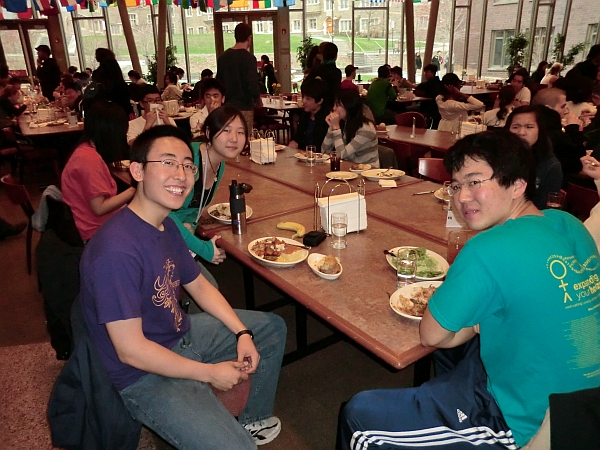
Ken doesn't looked happy because he's embarrassed for me that I just randomly asked a stranger to take a picture of us. He reiterated that I have no shame. Later that night, Ken was telling me about the spotlight effect that he learned about in his psychology class. People always think others are paying more attention to them than they really are. You observe the world from your own perspective, so naturally, you think others are watching you more closely than they really are. Well, I thought, if that's the case, you shouldn't really feel shame when you are doing things because people aren't really paying that close attention. Also, I don't really see what's shameful about asking a stranger to take a picture for you. Tourists do it all the time. Edit (5/14/11): Oh, I also saw and talked with Jonathan Wang (WP '07) at dinner.
After dinner, we went back to Ken's room to chill for a bit before heading to the Yamatai drumming show with Ken's girlfriend Olivia Hentz and her friend, whose name has slipped my mind. On our way there, the conversation somehow reached Madagascar, and then Ken said, "Anthony really likes the capital of Madagascar." With that statement, I was reminded of my Antananarivo chant, which I don't think I've spoken since high school. The way it usually happened was, Steve LaLuna would ask me, in a funny voice, "Hay Ahng-thuh-knee, wat's da cah-puh-tul of Mahdahgahscar?" and then start beat-boxing. Then I would come in with my rhythmic chant. It went something like this:
The chant goes on indefinitely, and the beat-boxer can riff and do funky rhythms. I'm glad Ken reminded me of this chant.
We got to Bailey Hall, where the taiko drumming show was taking place, and it reminded me of Richardson Auditorium at Princeton, where the Princeton Fall 2010 cubing competition took place. The show was very high-energy and the drumming was phenomenal. I personally thought it was of the same caliber as Blast! and drum corps percussion, and this was just a student group! As part of their show, Yamatai also did some acts with the Lion Dance group and the Chinese Music Ensemble. It was really cool to see some obscure (in the U.S.) Chinese instruments being played. I think one of them was a guzheng.
After the Yamatai show, we went to Duffield Hall, where there was a free food event going on. I'm still not entirely sure what the event was for, whether it was a fundraiser or a cultural event or an event to raise awareness about something. It was all Asian food, though, and there were some musicians performing, so I'm guessing it was some Asian cultural night event. Here, I also bumped into another GSETtler '07, Megan Lam.
After this - yes, there's more; Friday was a long (but very fun) day - we went to Olivia's room to chill for a bit. I did some more cubing demonstrations. Here are a couple smiling pictures of Ken:
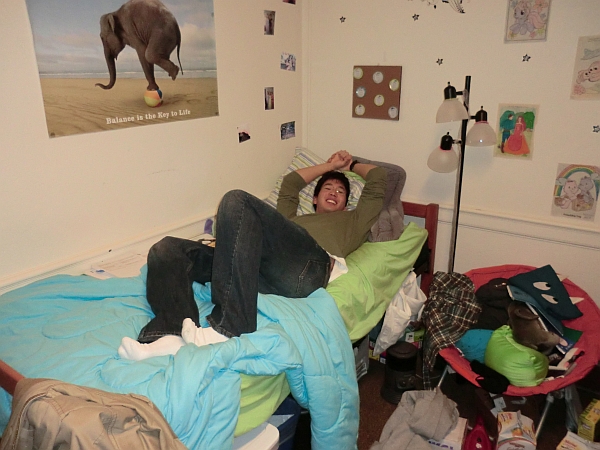

New profile pic, I think?
When we finally returned to Ken's dorm, we were both tired - Ken especially, because he didn't nap in class like I did and because he also worked out. Ken went to sleep first while I stayed awake to check my email and do some stuff. While I was doing my thing, suddenly, my computer started making this loud noise, about 60 decibels in intensity. My computer froze up a bit, and I just did a hard shutdown. The sound woke Ken up, and he asked me, "What was that?" I didn't know, but it sounded like a fan problem and not a hard drive problem. I took it as a sign to go to sleep, so I did.
End of Day 1.
| Lily wrote: Your entries are fantastic. I love that you carry your Rubik's cubes in a flute case. I can just imagine you wearing it slung over your chest like a bandolier, and then whipping out the right one when the time calls for it. Were you at Cornell for Slope Day? I think having no shame sounds like a bad thing, but the way that you lack shame is a positive quality. You don't let embarrassment get in the way of things. Poor Ken, though. You sound extremely unconcerned about your computer suddenly freezing up and making a loud noise?!?! My roommate's computer did that once. I think she had a Dell? It just started beeping at random and she like you had to force a hard shutdown. I wonder what the problem was.... | 11 May 11, 19:49 CDT |
| Erwa wrote: Haha. I had to go look up what a bandolier was. Thanks for expanding my vocabulary. Actually, I don't wear it; I carry it like a duffel bag. | 13 May 11, 22:11 CDT |
Post Comment
Cornell Visit, Day 2 (4/23)
Today was competition day! I woke up and ate the pizza slices and fries I took from the dining hall the night before (definitely not a breakfast of champions). Ken and I both showered and then we headed to Flora Rose House so Ken could grab some breakfast. Ken got me a banana and peanut butter bagel (no jelly - I prefer pure peanut butter sandwichs over PB&Js), which I saved for later. After breakfast, we walked for fifteen minutes from West Campus to North Campus and arrived at the Robert Purcell Community Center for the competition.
At most competitions I've been to, the first event is almost always the 3x3 speedsolve first round, but interestingly, the Cornell competition organizers decided to start with the Magic and Master Magic events, followed by the 5x5 speedsolve, before doing the 3x3 speedsolve first round. I've never really been interested in the Magic or Master Magic events - the starting and ending states are always the same for these puzzles, so this event is all about who can perform the transformation the fastest. The only variety in this event is pretty much whether one does the transformation "left-handed" or "right-handed". Also, another reason I dislike these puzzles is that the fishing wire that is used to string these puzzles sometimes comes loose or snaps, and it's very tedious to restring one of these puzzles. I do own a Rubik's Magic and have restrung it about five times, but ever since a string came loose again some time this past year, I haven't bothered to restring it. It's not a fun puzzle to practice.
Thus, my first event was the 5x5 speedsolve. I did some practice solves while the Magic and Master Magic events were happening, but my times weren't that great for me - they were in 2:15-2:30 range, but at home, I've gotten a sub-2-minute average of 12 before (My PR average of 12 is 1:58.87 set back on 1/9/10.). Then I decided to lubricate my cube, which definitely helped, as I was able to get some sub-2:15 solves after that. They called my name for the 5x5 event, so I brought up my 5x5 for scrambling and waited to do my first solve of the day. A few minutes later, I finished my first solve, which was a new official PR for me!:

The time was actually 1:57.02 (in the picture above, I haven't quite stopped the timer, yet) - my first ever official sub-2-minute solve. This was an awesome way to kick off the day. Then, on the next solve, I got an even faster time of 1:54.21. I followed that with two slow solves of 2:14.81 and 2:24.27, and finished with another sub-2-minute time of 1:57.15. After dropping my slowest and fastest times, my average turned out to be 2:02.99, another PR for me (my previous best average was 2:09.14, set at Princeton Fall 2010).
After the 5x5 event, Ken asked me if I wanted him to film my solves. This was an awesome idea! For the rest of the day, he very patiently filmed the rest of my solves. You can see all the solves in one playlist here.
The 5x5 and 3x3 speedsolve first round took less time than expected, so they added a 2x2 first round before lunch. I called Eric Huang in the morning, and he showed up shortly before lunch to see some of my 2x2 solves. Then, Ken, Eric, and I headed to the dining hall upstairs. I wasn't planning to eat because I wasn't hungry and I still had the banana and peanut butter bagel, so my plan was just to practice cubing while Ken and Eric ate. However, the dining hall swipe-in clerk said too many people had told her that they weren't going to eat but ended up eating anyways, so she couldn't let me in. Thus, I ended up going back to the multipurpose room where the competition was taking place and practicing there by myself.
In the afternoon, Olivia and another one of Ken's friends, Myron Zhang, also came to watch and support me. Right after lunch was the blindfolded event; this was the event I thought I had the best chance of winning. Unfortunately, I blanked on the edge permutation during the first solve, which was the easiest scramble to memorize. During the second solve - my only successful one - I took a bit longer than normal to memorize, but then I forgot the corner permutation. I skipped it and did the edge permutation first, and then all that was left was the corner permutation. As described above in my Cornell Visit, Day 0 post, I drew triangles in the air until I drew one that felt the same as the one I drew while memorizing the cube. I was correct and successfully solved the cube. On my third blindfolded attempt, I blanked again and DNF'd. Disappointingly, my best solve was a 3:37.65, which ranked me third.
Wanting to make up for it, I spontaneously got the idea to ask the competition organizers if I could do 4x4 blindfolded. They agreed, as long as I found someone to judge me. Ken kindly agreed. I actually hadn't even attempted a 4x4 blindfolded solve since Harvard Fall 2010, back in October. But it's not like I forgot how to do commutators since then, so I figured I could still solve a 4x4 blindfolded. I didn't even have time to do a practice solve, since each solve takes about 25 minutes. So I just started my first official attempt. I memorized slowly and carefully, and double and triple checked my memorization. Then I donned the blindfold and started solving. I solved very slowly, not wanting to make any mistakes. After I had executed everything I memorized, I thought I hadn't made any mistakes and had solved the cube successfully. But when I pulled off my blindfold, my cube was a jumble. Most of the centers were solved, but the edges and corners weren't even close. I don't know what happened. Well, after that, I decided not to waste any more of anybody's time (my DNF first attempt took 31 minutes total) and decided to scrap my second and third attempts. I wish I'd thought to ask the organizers ahead of time whether I could do 4x4 blindfolded. If they had said yes then, I would have practiced. Oh well. I could actually use a lot more practice in the blindfolded events; I think I have much room for improvement. I'll work on it for U.S. Nationals in August.
I got the idea in the middle of the day to use Caltech Cube Timer (CCT) on my computer to generate scrambles for me to practice with. I always trust computer-generated scrambles more than my hand scrambles because I do believe I probably have unconscious biases and tend to scramble in similar, not-so-random ways. I feel that by using computer-generated scrambles, I will get scrambles that are more random, like the official scrambles I will get. Also, if you mess up or have a good time, you can redo the scramble and see what you did. Shortly after booting up my computer, it suddenly started making the super loud fan noise again. My computer definitely had a problem. I hard shut it down and decided to look at it after the competition.
The rest of the afternoon was a lot of cubing, with the following highlights:
- I broke my official one-handed single solve PR in the first round of the event with a new best time of 24.38 (previous record was 26.21 set at Princeton Open 2008). Then, in the final round of the one-handed event, I broke this record again with a new fastest solve of 23.75. I choke on most of my other solves, so my average was not a PR.
- Erik Johnson broke the record for the fastest official Petrus solve with a solve of 10.86. The previous record was 11.19, set by me back at Rutgers Spring 2007, a time which is still my official 3x3 single solve PR. There's no way to prove that 10.86 and 11.19 are the fastest official Petrus solves, but we can be fairly confident they are because even four years ago, basically 99% of all speedcubers used the Fridrich method, so if somebody were fast and didn't use Fridrich, you knew who they were. I've since switched to Fridrich (I switched permanently on 3/10/10), so I'm no longer in contention for the fastest Petrus solve. I'd still use Petrus for fewest moves, though I haven't competed in this event since Princeton Open 2008.
- On my last 2x2 solve of the day, I finally broke my single solve PR with a new best of 3.31 seconds.Finally, almost five years after I got my former WR 2x2 single solve of 3.55, I broke it. Of course, the WR single now is 0.96, tied by three people, and the WR average is 2.12.

- I choked a bit in the final round of the 3x3 speedsolve, especially on my second solve of 19.15, where I dropped the cube twice at the end.
All in all, I was fairly happy with my performance at this competition, considering how little I practiced in the couple weeks leading up to this competition (I was pretty busy with my English final project and other assignments.). It was also nice to break a few PRs, especially my 2x2 single PR. Oh yeah, and what's really cool is the winner - Kevin Zhou - will be a freshman at Yale this fall!
After the competition, Olivia, Myron, Ken, and I headed back toward West Campus. On our way over, we debated what we thought the 3x3 single solve WR would be in five years. Myron thought it would be 2 seconds. The rest of us thought that was impossible. Every speedsolve almost certainly uses at least 35 turns to solve, and that's a conservative lower bound - most cubers probabaly use about 50-60 turns on average. So, even if you got lucky and were able to solve a cube in 35 turns, you'd still have to turn about 18 turns per second to solve it in 2 seconds. That's just not physically possible. Even if I do the fastest trigger I can over and over - something like (R U' R' U) - I can only average about 12 turns per second. When you factor in recognition time, regripping time, awkward move sequences - there's just no way you could solve a cube in 2 seconds. To be fair, five years ago, I thought 3x3 averages would stop increasing around 10 seconds, and the best single solve would be 7 or 8 seconds. Then this Australian kid named Feliks Zemdegs came along and shattered virtually every cube record, including the 3x3 records. The WR single and average are now 6.24 and 7.87, respectively. However, now we're reaching the physical limits of how fast one can turn. Yes, I can see Feliks getting lucky one day and posting a 5.xx solve (his 6.24 was a PLL skip). But even he can't average 18, or even 12, turns per second for an entire solve. By the time we got to the Alice Cook house, I had convinced Myron to revise his prediction. He changed it to "some time between 3 and 4 seconds".
At dinner, I saw another GSETtler '07 - Philip DiSanto. We played StarCraft together back at GSET, and then in college, we played on opposing school teams for Collegiate StarLeague (CSL). This was back when CSL was still StarCraft Brood War (SC BW), during my freshman and sophomore years of college. However, since StarCraft II came out last summer, CSL has switched to StarCraft II and I've more or less retired from SC. I no longer play for the Yale CSL team nor follow the CSL scene, though Philip still plays for the Cornell team. We reminisced about the Brood War days, though, and talked about how SC 2 is very different. There's so much history to SC BW that those who just started with SC 2 don't know and can't appreciate. Heh, I guess this is just the rant of a crotchety old SC player like me. Anyhows, it was good to see Philip again. He's also working for Google this summer, though in the New York City office, whereas I will be at Google HQ in Mountain View, California.
After dinner, Myron left, and Ken and I went back to his dorm. Ken did some work while I investigated my computer's fan issue. While I was taking apart my computer, Ken pointed out that the grate on the bottom of my computer was cracked and pressing down on the fan case. Ah, that was the problem. My fan case was dented and the fan was hitting against the case. So I disassembled most of my computer to get to the fan case, unbent it by hand (it's pretty thin metal), and reassembled the computer again. During this assembly process, I thought to myself how fortuitous it was that I had brought a Philips screwdriver with me, which I had brought with the intention of adjusting the spring tension of my cubes if necessary, not for repairing my computer. I also thought how much more technician-friendly PCs are than Macs. The battery, memory, hard drive, etc., are all so much easier to remove on PCs than on modern unibody Macs. And, you only need one size and type of screwdriver - a medium-sized Philips screwdriver - to disassemble a PC as opposed to three different types of screwdrivers (Philips, hexagonal, and tripod-shaped) to disassemble a Mac.
After I finished reassembling the computer, I turned it on and there was no more fan noise. Hurray! Then I realized the keyboard wasn't working. I had forgot to plug in the keyboard cable. Ugh. So I disassembled my computer part way again to plug in the keyboard, and that was that.
Saturday night, Ken and I played Bananagrams with Myron and his friend (Brian?) in a group study room. In case you don't know, Bananagrams is sort of like real-time Scrabble (as opposed to turn-based). However, there are no points. Each player (or team) has a separate "board" (there is no physical board; you just use the table; you have unlimited space in all directions). Once you use up all your letters, you say "peel", and both teams must take a new letter from the pile of flipped-over letters. Once you use your new letter (and any letters you had left over from before), you say "peel" again, and both teams have to draw another letter. This continues until there are no more letters left in the draw pile. At this point, whichever team uses all their letters first yells "bananas" to claim victory. As long as all the words are valid (verified by the opposing team), they win; otherwise, they become rotten bananas and the other team wins.
The strategy in Bananagrams is very different than that in Scrabble. Whereas in Scrabble, you want to try to make long words to score lots of points, and you have to think carefully about your word placement, so as not to give your opponents a triple word score, in Bananagrams, the strategy is often to make lots of short words and make your chain of words sprawl out widely in all directions, to give you as many points as possible to connect new words. Bananagrams is more about speed and reaction time, I think, but the fast-paced action is fun.
- Ken and I were a team, and in one round, we yelled "Bananas!" first, but then we got challenged on "villify" and discovered that the word is actually spelled with one L as 'vilify'.
- In a different match, we got challenged on "acquiesced". When we looked it up at hasbro.com/scrabble, it was not found! Then we realized this was because 'acquiesced' is longer than eight letters, and hasbro.com/scrabble only has 2-8 letter words. But according to the Scrabble Association rules, for a word with more than nine letters to be valid, it must appear in the Long List, which is compiled from Merriam-Webster's Collegiate Dictionary, 10th edition. 'Acquiesced' certainly appears in Merriam-Webster's, so it was valid. At first, Ken and I were going to go with 'quiesced', but we weren't 100% sure that this was a valid word. Later, we got another C, so we changed quiesced to acquiesced. Interestingly, quiesce(d) is a valid word in the SOWPODS word list, which is the primary dictionary used in Scrabble tournaments worldwide, but not in the TWL word list, which is used mainly in North American tournaments. To download a copy of these word lists, go here. Note that hasbro.com/scrabble uses the TWL word list, but only has 2-8 letter root words (not counting suffixes). To verify a word against the SOWPODS word list, either download the list here, or use the Collins Scrabble Checker.
- In another round, I wasn't sure about the word 'equine', but Ken was very confident it was a word. He was right - it basically means horse. The next day, I was looking at a Cornell Campus Map, and I saw Equine Research Park on it. It's funny how after you've learned a word, you suddenly notice it more often.
After Bananagrams, we were all pretty tired from a long day, so we went to sleep.
End of Day 2.
Cornell Visit, Day 3 (Sunday, 4/24)
Sunday was a slow day. I woke up around 10 am and ate the food I took from Alice Cook the night before. Then I went outside to the lounge to check my email and surf the web. That's when I noticed my speakers weren't working. However, if I plugged in my headphones, I could still hear sound. Looked like I had forgotten to connect the speaker cable to the motherboard. So, for the third time during this visit, I disassembled my computer.
Ken woke up and brought his computer outside as well. He started working on a philosophy paper. Before I finished reassembling my computer, Ken had to leave to do something. That's when I got the idea to contact all the Gov School people I hadn't met up with yet to see if they were free today to meet up. However, since my computer was still disassembled and unusable, I used Ken's computer. Even though Ken's account was locked, conveniently, I could still log in on the Guest account. I did, and I checked my Facebook, where I found a message from Kevin Shannon. He had given me his number, so I called him up and scheduled brunch with him after I finished reassembling my computer.
I had stripped my computer down to the motherboard again, and this time, I thoroughly checked that all the cables were plugged in to it before I started reassembling the computer. I had reassembled most of it and had started replacing the screws on the bottom of the computer when I realized that I had a lot more screws left than were needed on the bottom of the computer. I quickly realized that they were motherboard screws I had forgotten to replace. So I disassembled my computer for the fourth time, replaced the motherboard screws, and reassembled everything again. I turned on my computer again, and hurray!, everything, speakers and all, worked again. In the process of fixing a simple dented fan case problem, I had inadvertently created several other problems (a sort of two steps forward, one step backward situation). However, fortunately, in the end, everything was fixed (though I had one extra screw at the end, which I just threw away), and my computer has worked without problems in the month since.
After I reassembled my computer, I decided to cube for a bit. Ken had returned at this point and continued working on his paper. He also told me he had to go to the lab soon, and I would not be able to get into his room after he left. So I got my backpack and some work out of his room. After cubing for a while more, I realized I was late for brunch with Kevin! I put my laptop and my work in my backpack and headed out. Ken said he would be gone and at his lab by the time I got back.
I found Kevin's fraternity house, Lambda Chi Alpha, where we were meeting, without much problem, having studied Google Maps before I left. Cornell has a huge campus and lots of space, so all the fraternities and sororities on campus have houses. Lambda Chi has its own chef who cooks meals for them. I got there and we went down to the basement, where the kitchen was. Kevin ordered an omelet while I ordered a ham, egg, and cheese sandwich.
We ate outside the kitchen in the main atrium of the basement, where a party had taken place the night before. The place smelled disgusting. The rank odor of beer was overwhelming. I would not want to live here and eat in such a smelly room every day. After brunch, we went out a back door to check out the view. There wasn't much of a backyard; instead, the Lambda Chi house overlooked a stream some 100 feet below it. There was even a small series of mini-waterfalls a little ways upstream. The coolest part was this gazebo that had been erected on the side of the cliff. Who knows how it was built originally. It seemed that with each subsequent rain, a bit more of the dirt foundation of the gazebo would wash away. I can imagine that in ten years or so, the gazebo might become unsafe to use or might just break off and fall down into the stream.
After checking out this vista point (dang, I should have taken some photos), we went back inside and Kevin gave me a tour of the rest of the house. The library was a mess - there were beer cans on the ground and the table, and books strewn haphazardly around. It did not seem like a very friendly work environment. Next, we went to the living room, where a few brothers were watching a basketball game on their TV, which was a huge projection onto a white wall. Again, there were empty cans and wrappers and other garbage scattered all over the ground. I would not be able to stand living in such an environment. Such slobbiness and messiness just bothers me and distracts me. I am a firm believer of Cal Newport's tip "Make Your Bed Everyday", which is not specifically about always making your bed, but more about always keeping your room clean and organized and taking out the trash frequently. A cluttered room clutters and distracts your mind; a clean and organized room keeps your mind fresh and focused.
Next, we went upstairs to check out the gym. The gym had a substantial amount of equipment, but the entrance of the gym was just flooded with bags of overflowing garbage, clothes, and shoes, which we had to step over to get to the gym equipment.
The last place we visited was Kevin's room, which he shared with the current president of Lambda Chi. This was the nicest room I saw during the entire tour. I guess part of the reason was just because the room was fully furnished and had a lot of stuff in it, which gave it a cozy, homely feel to it. It was also relatively clean, compared to most people's rooms I've seen.
That concluded my tour of the Lambda Chi house, though thinking back, I am kind of curious what the bathrooms were like. I left and went back to the Hans Bethe House. I was glad to be back in a clean and non-smelly environment. It kind of felt like returning from the wild back to civilization.
Ken was hard at work in his lab, so I decided to go do some work myself. I didn't feel like working on my Randomized Algorithms pset, so instead, I went down to the basement intending to practice for my keyboard lab final in the music room. (I had to follow someone into the elevator in order to get to the basement because you need to swipe your Cornell ID to summon the elevator or even to enter the stairwell (!).) However, when I got to the basement, there was already a violinist using the music room.
So, while I waited to practice, I went to the TV lounge and practiced some cubing. After a little while, I checked the music room again and it was empty. I spent an hour or so working on my two keyboard lab final pieces: Handel's Messiah (I had to play the bass line while accompanying it by playing chords with my right hand (a.k.a. figured bass)) and one of the Yale fight songs, "Boola Boola", which is written in C major but I had to transpose to Bb and D major.
Afterward, I returned to the TV lounge and attempted to work on my Randomized Algorithms pset. I read my professor's class notes for a little bit and my eyes soon glazed over. I decided to take a nap. (Falling asleep soon after attempting Randomized Algorithms work seems to have been a common theme this semester for me (see my 2011 Hopkins visit post for another example). I think I get frustrated and tired really easily when I don't understand stuff or am working on something very difficult.) Anywho, I didn't sleep long before two guys came into the lounge. They were sorry to wake me up but asked me if they could watch the last few minutes of the Miami-Philly NBA playoffs game. I said sure. There were less than two minutes remaining in the game, and the 76ers were down by 6 points. The Heat were already leading the series 3-0, and I thought they would wrap up the series this game. However, the 76ers made a remarkable 10-point run and ended up winning the game. It was a pretty exciting final few minutes! (Nevertheless, Miami ended up winning the series the next game.)
At this point, I needed to use the bathroom. However, there were none in the basement. And I couldn't get out of the basement because you need a Cornell ID to summon the elevator or enter the stairwell (if you try to enter the stairwell without using your ID, you will set off the alarm). This struck me as an idiotic building design. I looked around for a number I could call to get someone to come rescue me. I didn't see any numbers posted. So I tried calling 911 instead. But despite the fact that I had a full six bars of service in the basement, my cell phone told me the call could not be completed. What the heck? 911 is never supposed to fail when you have service in the States!
Well, anyhows, I checked the laundry room and found that quite a few washers and dryers were in use, so I figured someone would come down soon to pick up or continue his laundry and simultaneously free me from the basement. In the mean time, I called Ken to see how he was doing. I explained to him my predicament and he told me not to pee in the sink. I didn't even realize there was a sink in the basement, but I promised him I wouldn't. After the call, I checked the laundry room again and found the sink Ken was talking about. I did not pee in it.
I went back out in the hallway and positioned myself midway between the elevator and the stairwell door and continuously glanced back and forth between them, ready to sprint to the one that opened first. Within five minutes, the stairwell door opened and I was saved. I went back upstairs to the first floor and was able to relieve myself.
Ken said he had to work a little bit longer today in the lab, so I went to the first floor lounge (where I had wanted to sleep the first night) and wasted some more time on my computer.
Ken finally got out around 7:45 PM and told me to meet him directly at Alice Cook House for dinner, since the dining hall closes at 8 PM. We made it there before closing and gorged ourselves with food. I again packed some food in a napkin to eat the next day.
Sunday night, it was time for Ken to do laundry. Since I did not have too many dirty clothes myself, I asked if I could throw my dirty clothes in with his. He said okay. While we were waiting for the laundry to wash and dry, we both bummed around in his room. Ken did not have any work due the following day, and he really did not feel like working on his philosophy paper, so he decided to procrastinate by working on his pchem homework. I remarked that this was a good way to procrastinate - to get done other work when you're putting off some specific work. Also, I observed that Ken practiced Cal Newport's tip "Do Work Every Single Day". Even though he had nothing due the next day, he still did some work on Sunday. Too often, I let weekends pass without accomplishing any work. I need to start making it a habit to do a little bit of work each day, even if I am very busy the whole day and pretty tired when I finally have time to do work.
(Aside: Something that Officer Kelly told me in the Drug Abuse Resistance Education (D.A.R.E.) program way back in elementary school has always stuck with me. He said that when you have multiple things to do, you should always do the hardest thing or the thing you are looking forward to least first. We had a little debate about this in class after he told us. Some people thought it was better to knock out the simple tasks first so that you could focus your remaining time on the difficult task. Also, by doing the smaller tasks first, you are able to get a sense of accomplishment, which can help motivate you to finish the rest of your work. I used to think simple stuff first was the way to go, but as I've thought more about what Officer Kelly said over the years, I've come to believe that he is right. When you start working and are still fresh with abundant energy, you should use your optimal mindset to tackle something difficult or unpleasant to you. Once you've completed the toughest task, the rest of the tasks will seem much easier. Usually, the easier tasks are things that you're very good at or used to doing, and you usually enjoy doing these things. In my case, the challenging assignment would be an essay while an easier task would be a weekly math pset (linear algebra, not randomized algorithms). Following this hardest-thing-first strategy, I should work on my essay first before turning my attention to the math pset. Another random tangent: Something that Joshua Foer mentioned in Moonwalking with Einstein is that as we do a task over and over and become better at it, we strengthen the neural circuits in our brain associated with that task, and those circuits become more efficient. That means we are able to do the same tasks using less energy. However, when we do something new or challenging for us, we have to expend a lot of energy creating new neural circuits in our brain. That's why it's often exhausting learning something new or working on something difficult. But to get better at anything and avoid the autonomous third phase of learning something, we should be forcing ourselves to tackle the hardest things first. Only by spending more of our time and energy on the difficult things will we be able to strengthen those circuits in our mind and turn those difficult tasks into easy ones.)
Ken picked up his laundry and dumped it on his bed. Conveniently, we wore different types of socks and underwear, so I was easily able to pick out my clothes from his. Ken then called Ashley, whom I had met at lunch on my first day. Ashley came and began folding Ken's laundry. I asked them about this arrangement, and Ken explained that Ashley and he had met while playing intramural volleyball the previous year. However, since Ken was so much busier this year, he had to drop volleyball. Consequently, Ashley and Ken did not get to see each other very often. Thus, when Ashley came once per week to fold Ken's laundry, this was an opportunity for them to catch up.
We got to chatting about cubing, and I mentioned feet cubing, which prompted Ashley to ask for a demonstration. I then did my first feet solve in years:
The solve was just under four minutes (3:51.77). My best feet solve single and average, though, are 2:13.37 and 3:31.68, respectively, both set on Christmas Day 2006. In case you're curious, the current feet solve single and average WRs are 31.56 and 39.98, held by Finnish cuber Anssi Vanhala. That's insane. There was a time when I couldn't even solve a cube one-handed that fast. Actually, I still sometimes get one-handed times that are slower than the feet WR average. (The story behind how Anssi Vanhala got so good at feet cubing is that he had cubed too much with his hands and gotten cubist's thumb, so while he was resting his hands and letting them recover, he thought, why not practice feet cubing? Thus he did and became beast at it.)
Ashley hung around for a while longer and we talked about some random things. I continued sitting on the floor and cubing while I heard Ashley and Ken looking through some people's Facebook photos and commenting on how they looked and what they thought of them.
After Ashley left, Ken and I chatted some more about random things. I encouraged Ken to do more random things and things for fun, such as playing volleyball again. The way Ken sees it, though, is you work hard now so that you can have an easier life later. I disagree with this perspective. I personally think you'll be working very hard for most of your life in the real world, so you should really try to enjoy your time now while you can. Also, no matter what stage of your life you are at, you should always be having fun and doing some things only for yourself and not for the purpose of "getting ahead" in this world or because someone expects you to do something. One life to live, baby, so if you aren't having fun and experiencing things, you're probably doing something wrong.
Pretty soon, Sunday was over. I fixed my computer, had brunch with a friend, practiced piano, got stuck in the basement, did some work, had dinner, chilled, chatted, and went to sleep. It didn't feel like I did much (certainly much less than I did on Friday and Saturday), and yet, a whole day passed just like that.
End of Day 3.
Post Comment