East Coast Visit 2013
After I ended at Microsoft and before starting at LinkedIn, I took three weeks of vacation. The first week, I spent in the Bay Area, checking out various places in SF: the Cable Car Museum, the Cartoon Art Museum, the Exploratorium, Coit Tower, the Walt Disney Family Museum, and Planet Granite SF. For the remaining two weeks, I decided to fly back to the East Coast and catch up with friends and family. The trip was very rejuvenating and fun. First an overview, and then some highlights.
Overview
I flew in to Baltimore and then worked my way up the East Coast to Boston. First weekend with Andy, then a few days in Jersey with family and the WP gang. Next I hit up NYC, crashing at Columbia. Following that was a cubing competition in Norwalk, Connecticut, then train to Yale. The last few days, I spent hopping around Cambridge and Boston.
Highlights
Day in DC. On the second day of my trip, Andy and I drove down to D.C. and spent a day with Lillian, William, and Jeffrey. First, we went to the Smithsonian National Air & Space Museum. Before planning this outing, I had no idea that the Smithsonian Museums are all free! That is so amazing! And despite being free, the National Air & Space Museum was great -- we didn't even see the whole thing in the 3 hours we spent there. And from what I hear, the other museums are just as good. I also thought the Air & Space Museum did a balanced historical presentation -- it not only discussed American air and space achievements, but also documented those of other countries, including showcasing German technologies and uniforms during the two World Wars and Russian spacecraft during the space race.
Afterward, we strolled down the National Mall, past the Washington Monument (under repairs indefinitely) and the World War II Memorial, along the Reflecting Pool, to the Lincoln Memorial. Seeing the glorious carving of Lincoln and reading his Gettysburg and Second Inaugural Addresses etched on the walls, I was reminded of A.P. U.S. History I with Mr. Schwartz. What a great man Lincoln was. A very fitting memorial.
Walking around D.C. and visiting these museums and historical sites, I really felt great pride for my country and admiration for the great people and accomplishments our nation has produced. I must have been too young the first time I went to D.C., because all these places seemed new to me. I would really love to take another vacation to D.C. and explore all the museums and memorials in depth.
Poopgate. My first night at Yale, I asked Ike and Kevin (my hosts and also fellow cubers) what interesting things have been happening at Yale lately. One of the first things Ike mentioned was several incidents that had occurred in the Saybrook laundry room. Apparently, a girl had went to pick up her laundry and found her clothes covered in human feces. She apparently reported it to the dean's office, but the dean told her that wasn't funny. It happened again a week later to another girl, and this time, she brought the clothes with the excrement on it to the dean's office. The dean still didn't believe it was poop at first, but after looking closer and smelling it, she finally believed it.
I asked some more people about the incident, and one person told me they had caught the perpetrator. It was apparently a girl who was doing this to girls she didn't like.
Of course this would suck and be disgusting if it happened to you. However, I also think this prank/form of revenge is hilarious. How does someone think up something like this? It also takes planning and patience to execute something like this. You have to know or find out when your target does their laundry. Then you have to wait for the person to put their laundry in the dryer and leave. Only then can you strike. But you can't just expect your bodily rhythms to align with your target's laundry cycle. You have to prepare your crud ahead of time. I heard that the perpetrator would poop in a cup and then smuggle it to the laundry room when she was ready to use it. What about the smell? Do you need to try and mask that? And if you're storing the poop ahead of time, where do you store it? If you have roommates, aren't they going to smell it? There are quite a lot of components to figure out in order to execute this prank. It was very amusing thinking about the execution and the fact that someone actually pulled this off. Apparently, this incident even inspired a copy-cat incident in another residential college, Silliman.
There are even news articles about this: http://www.yalerumpus.com/blog/saybrook-laundry-vandal-gives-a-whole-new-meaning-to-dirty-laundry/, http://yaledailynews.com/blog/2013/10/02/police-probe-saybrook-laundry-incident/, http://yaledailynews.com/crosscampus/2013/10/07/poopetrator-still-at-large/
Keith Wilson Memorial Concert. One of things I miss most in my post-college life is playing clarinet, especially with a band or in a pit orchestra. So while planning this trip, one of the things I asked some band friends about was whether there were any concerts the I was visiting. There were no formal, publicized concerts, but there was a memorial service for Keith Wilson, former Yale Bands director, at which the Yale Concert Band was performing.
I never met Keith Wilson, but I did know that he was a clarinetist, and the first chair clarinet seat in the Yale Concert Band is named the Keith L. Wilson Memorial Chair in his honor. His children spoke at the memorial service and many friends shared their reflections as well. Though I did not know him personally, from what I heard, it was clear to me that Wilson was very dedicated to his students. My former band directors and music teachers are definitely some of the biggest influences in my life, and I have the utmost respect and admiration for their selfless service to their students. Wilson was surely such a person to many students.
In addition to learning more about Keith Wilson, I also got to hear lots of clarinet music during the service. While waiting to start, they played a recording of a Mozart Clarinet Quintet. During the service, Richard Stoltzman, a well-known and recognized clarinetist, performed the first movement of the Hindemith Clarinet Sonata. Finally, a group of graduate music students performed a recently-composed clarinet-only piece. You rarely get to hear so much clarinet solo repertoire in one concert, so this was quite a treat!
Breaking into Joy's apartment. My first day in Cambridge, I stayed with Joy. I met her at the train station, we went and bought some groceries together, and then we went back to her place to make dinner together. When we got to her house, she realized that she had left her keys at her office! None of her housemates were home yet, and rather than waiting 45 minutes for one of her housemates to get back, I decided to put my rock climbing skills to use. Joy told me she usually leaves her living room window unlocked. This window overlooks a balcony. So I climbed onto the front porch, grabbed onto the balcony bannister, and hoisted myself up. After a bit of finnagling, I managed to lower half the window and climb in. Success!
We then made stuffed peppers and prosciutto pizza. It was lots of fun and super delicious! Definitely a very memorable and enjoyable evening. Cooking together is a fun and satisfying group activity!
Figuring out William's puzzles. My second night in Cambridge, I stayed at Harvard with William Chen (different William than the WP William). He's also a cuber, and in addition to the standard WCA competition puzzles, he also had a bunch of funky puzzles, like the Octahedron, 3x3x2 (floppy cube), and a gear cube:

Source: http://www.said-on-net.com/shop/product/3x3x3-Rubik-Cube-Octahedron-Twist-Puzzle-Toy-White.html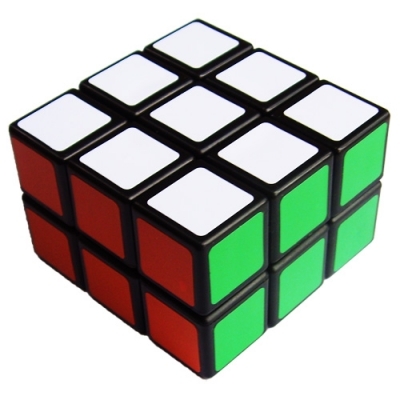
Source: http://www.puzl.co.uk/fully-functional-3x3x2-cube-p-317.html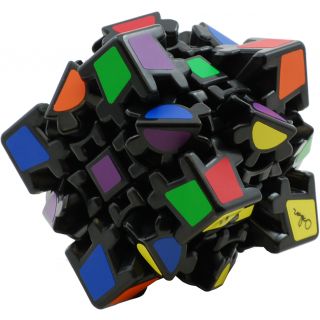
Source: http://www.puzzlemaster.ca/browse/cubepuzzle/mefferts/3205-gear-cube-black
I never figured out the original 3x3x3 Rubik's Cube by myself, but since learning commutators, I can now solve a cube using only logic and move sequences that I fully understand, without using any "magic" algorithms that solve certain patterns. Using this commutator principle, you can solve most twisty puzzles. However, constructing commutators still takes some trial and error. Whenever I see a new twisty puzzle, I like to try and figure it out myself. While staying with William, I figured out the Octahedron and 3x3x2 puzzles. However, I didn't finish figuring out the Gear Cube before I had to leave. William generously gave me the Gear Cube, along with a MoYu 3x3x3, now one of the most popular 3x3x3 speedcubes. Later on Wednesday, while chilling in Ken's lab, I figured out the remaining algorithms I needed to solve the Gear Cube. Figuring stuff out, whether it's programming interview questions or mechanical puzzles or deriving equations during a test, is still one of life's most satisfying pleasures.
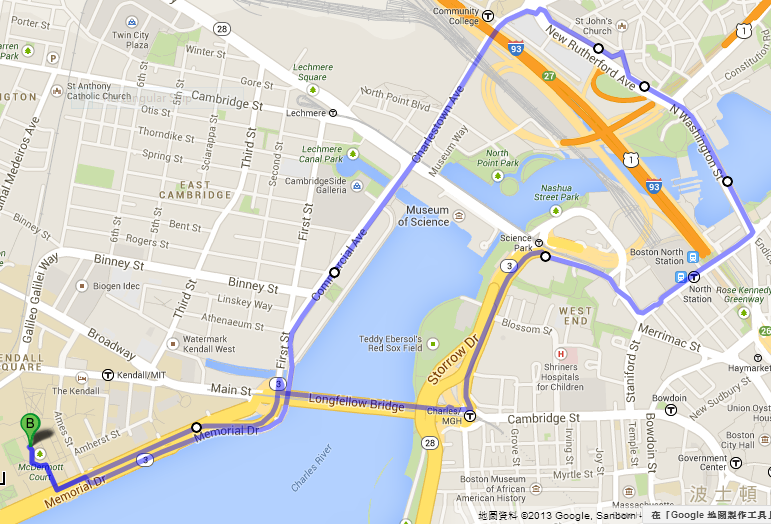
Getting lost on a long run. After solving the Gear Cube, I decided to go for a tempo run. It was part of my training schedule for an upcoming 10K race. Start slow and easy, then gradually build up to 5-10 minutes of hard, race pace, and then taper off and end with 5-10 minutes easy pace. About 5 miles. This was my planned route:
And this was approximately my actual route:
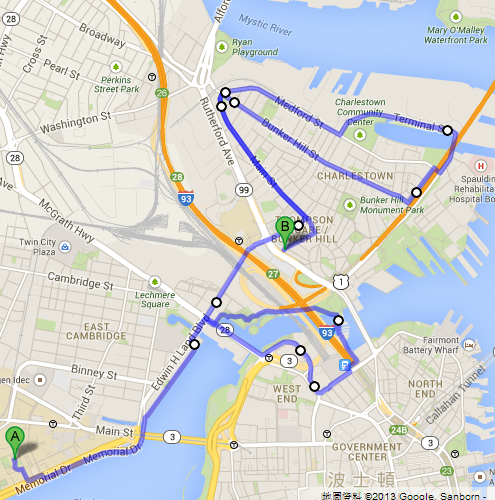
I messed up the beginning of my route and took a path under the first bridge (the Longfellow Bridge), which I had originally planned to take to cross into Boston. After messing that up, I decided to try to run my planned route in reverse. After crossing under a few more bridges (railroad bridges and highways), I thought it was about time to cross into Boston. So I crossed over a dam into Boston.
After entering Boston, I knew I had to head west and cross over another bridge back into Cambridge. I knew I was facing south, so I figured if I just kept making right turns and just ran along the Charles River, I would eventually reach a bridge and be able to cross back into Cambridge. Well, I crossed a bridge (route 28 on the map) without knowing it. The bridge was completely flat, water on one side, and a Museum of Science on the other side. While running across the bridge, I thought I was tracing the Charles River from the Boston side. When I lost sight of the water, I decided to turn right again. Since I was actually already in Cambridge, this caused me to veer completely off course toward Charlestown.
The rest of my run through Charlestown is uncertain. I only remember certain landmarks and roads, but I am unable to recreate my exact route. At one point, I ran the entire length of Bunker Hill St, which was a hilly street. I remember reaching Terminal St and thinking the Mystic River to the north was the Charles River.
I ran some more, and eventually, I decided I was utterly lost and it was time to ask for directions (I needed to get back so that I could go for another run with Joy and then eat dinner with some friends.). I finally stopped at a pub named Old Sully's (point B on the map) and asked for directions. The bartender pointed me in the direction of MIT. I started running in the direction he pointed, and I happened to come upon a T station (the circled T to the left of point B). Thank god I had been running with my wallet, which allowed me to take the T back to MIT. Only when I looked at the subway map did I realize how astray I had gone. And despite being on the Cambridge side of the Charles River, to get from that T station to the MIT T station, I still had to first cross into Boston, then transfer to another line, and then cross back into Cambridge. Ultimately, I made it back in time, went on another run with Joy, and then ate dinner in Boston with Joy, Ken, and some other Yalies.
Conclusion
What a wonderful trip this was! Exactly my idea of a good vacation: spending time with friends and family, seeing magnificent new sites, learning something, and experiencing a bit of adventure along the way.
| Lily wrote: Cannot believe you decided to go for a five mile run in an unfamiliar city. I MIGHT consider it since I have a phone, but... | 14 Dec 13, 17:53 UTC |
| Andy wrote: Haha, this was a good post. You forgot the part where we played awesome board games at Lily's house. | 18 Dec 13, 13:10 UTC |
| Crystal wrote: You were at Columbia? I completely missed you. Not a surprise since... I never pester you at all, but I still feel the urge to execute an 'oh snap' of the thwarted variety. This was a really fun post to read - I'm glad to find that you still blog. | 21 Dec 13, 07:48 UTC |
Post Comment
1 Accomplishment, 1 Commitment, 1 Thought
It's the end of another year, so it's time to reflect and to plan. Rather than go in-depth about what I did in 2013 and what I plan to do in 2014, I've decided to just focus on my single proudest accomplishment of 2013, my top commitment for 2014, and one idea to guide my thinking for next year.
Accomplishment
The 2013 accomplishment I'm most proud of is finishing my first book in Chinese. The book was a translation of The Wednesday Wars by Gary Schmidt, a children's book about a seventh grader named Holling Hoodhood's 1967-1968 school year. I started reading the book in October 2012 and finally finished it in July 2013 after spending about 120 hours reading it and looking up all the words I didn't know. The book was around 360 pages, so I averaged about 20 minutes per page.
Growing up, I attended Chinese school for 10 years, from 2nd through 11th grades. In college, I also took one semester of Chinese to fulfill my language requirement. And despite all this time invested, I still consider myself illiterate. I still can't comprehend the Chinese newspaper. So I've made it a long-term goal to improve my Chinese to the point where I can comprehend Chinese newspaper articles.
Reading a book in Chinese was a first step and helped improve my Chinese vocabulary a lot. However, the vocabulary set of a children's novel set in the 1960s is somewhat limited. Improving one's language skills requires constant and varied practice. I realized I spend so much time on a computer that one easy way to increase my exposure to Chinese was to set as many language settings to Chinese as I could: Windows, Thunderbird, OS X on my work laptop, Chrome, my Google account, Facebook. In addition, whenever my mom forwards me Chinese chain emails or YouTube videos, I use them as an opportunity to practice my Chinese and learn a few new words. I keep a Google Doc spreadsheet with all the phrases and words I've encountered along with their pinyin and English translation. There's over 8000 rows, but I still feel my vocabulary is weak (due partly to me forgetting words and phrases). I also sometimes write emails and cards to my parents and Andy in Chinese. I try to talk to family members in Chinese. When I buy goods and get user manuals printed in 12 different languages, I read the Chinese translation. I try to read as many Chinese signs as I can and try to remember the ones I don't understand so that I can go home and look up the words.
I feel that my Chinese has improved greatly during this past year of dedicated study. I can now get the main gist of most signs and webpages displayed in Chinese. However, there is still an enormous amount that I can improve. Besides improving my vocabulary, my grammar could use a lot of work. When writing, I still have a lot of trouble finding the right conjunction or transition word. I still don't have an intuitive sense of which preposition to use in a given situation. Also, when there are multiple words that mean similar things, it's difficult for me to choose the "most natural" one. I lack the experience to know which expressions are more common and what connotations each has.
Of course it's useful to improve my Chinese, since my family is Chinese. It's also the language with the most speakers in the world. And China is an emerging global market, one that lots of companies are trying to break into. But learning and improving my Chinese is also fun. It's like honing a craft. I've always been a fan of self-improvement. It's rewarding and satisfying improving your skill at something. And it's not stressful like playing a game can be. There are no winners or losers.
Commitment
My top goal for 2014 is to run and complete my first marathon. I ran my first half marathon - the San Francisco Marathon 2nd Half - in 2011 - and every year since, I've been meaning to run the full marathon. In 2012, these plans were derailed by a lack of training during a busy last semester of college and a one-month family vacation to China and Taiwan right before the marathon -- I wasn't going to train while on vacation.
In 2013, after I started working full-time and settled into a regular schedule, I committed to Hal Higdon's 18-week novice marathon training guide. I stayed pretty true to the schedule in the first half, even running a half marathon at the end of week 8. However, in the second half of the training, my discipline started faltering, and my knees and feet started to hurt at the end of my long runs, especially the 15+ mile runs. That's when I realized the importance of good running shoes. I invested $160 in a pair of Asics running shoes. Nonetheless, I decided to not overdo it and postponed my first full marathon -- I still ran just a half marathon - the SF Marathon 1st Half. The training I did paid off -- I set a PR of 1:43:41 (7:55 mile pace), despite running the harder half of the SF Marathon. The new shoes probably helped, too -- I definitely felt less tired and achy after the race than in previous years. I could also feel the shoe padding absorbing impact shock, especially on the steep downhills.
This year, I plan to follow Hal Higdon's training guide again. I plan to train only in my Asics running shoes, and to buy a new pair a couple months before the marathon for racing with. I'm determined to run a marathon this year. I hope it's the San Francisco Marathon, which includes a marvelous portion across and back the Golden Gate Bridge. But if this plan gets derailed for whatever reason, I will continue training and run another marathon. Fortunately, there are marathons happening every weekend, so finding another one should not be a problem.
My goal is to run my first full marathon in under 4 hours (9:09 mile pace).
Thought
Finally, I'd like to end with a thought that's recently been on my mind that I hope to keep very present in the coming year:

Annual review is coming up at work, and this is an opportunity to get feedback. It's important to be grateful for any feedback you get and to never take it personally. Usually, people don't freely give feedback. You generally have to ask. It's hard to tell what other people are thinking or how they perceive you, unless they give you feedback.
This information is so valuable. A music teacher is constantly giving their pupils feedback during a lesson. Coaches do the same. By getting this frequent feedback, students are able to refine their skills and improve quickly.
In less structured environments, it's much harder to get feedback. Feedback on how you're doing, whether you have personality traits that irk those you work with, whether certain behaviors offend others. Also feedback on what your weaknesses are, ideas for how you could improve, and things other people think you do well.
Without feedback, you're just making assumptions. I recently read a book called The Lean Startup by Eric Ries, and in it, he talks about startups that fail because they spend years trying to build the "perfect product," and when they finally release it, nobody wants to use it. Instead, Ries argues, startups should try to build a minimum viable product (MVP) and put it out there as quickly as possible in order to start the build-measure-learn feedback loop. Ultimately, who determines a company's success is its customers, so you want to get customer feedback often and then iterate using that new knowledge. Some companies (and people) are afraid of doing things or putting products out there because they are afraid of the negative publicity or feedback they may receive. But again, these companies (and people) are making assumptions! You don't really know until you ask and get actual feedback. Even if the feedback is negative, if it's constructive, you get information and suggestions on how you could improve, and this helps guide your direction for the future. This is much better than wandering aimlessly in the dark, guessing at what the right direction is.
Not all feedback is polite. Some come as harsh criticisms or angry outbursts. But you should be grateful for this kind of feedback as well. These are gifts, too. Someone cared enough or was upset enough to provide tough feedback. It's feedback nonetheless and gives you knowledge and guidance.
Thus, I think we should always be grateful, not defensive, when people give us feedback. If feedback confuses you or you disagree with it, ask clarifying questions to better understand where someone is coming from.
In the real world, feedback is rare, so when you get some, treasure it like a gift.
| Andy wrote: Your Chinese has definitely improved a lot! Great work! 做得好! | 21 Jan 14, 23:34 UTC |
| Joy wrote: 張安, | 26 Feb 14, 21:39 UTC |
Post Comment